
Unexpected balance loss on stairs can develop quickly, leaving little time to locate and grasp a secure support. Dual Railings: Why One Handrail Isn’t Enough for Balance Recovery is a practical question for anyone planning safer stairs, especially when aging in place or changing mobility makes a dependable handhold more important.
Key Takeaways
| Question | Short answer |
|---|---|
| Why consider dual railings? | Two rails can make a handhold available on either side, including when a person approaches from a different position or cannot comfortably reach one side. |
| Does everyone need two handrails? | No. The right setup depends on the staircase, the person using it, and the home’s structure. |
| Are two rails a substitute for balance care? | No. Handrails support safer movement through the home, but they do not diagnose or treat balance problems. |
| What can a home safety review cover? | We can review stair routes, existing rail security, traction, visibility, and pathway lighting in a stair and handrail safety review. |
| Does the standard stair package include new rails? | No. Major new handrail systems are evaluated and quoted separately after reviewing the stairs and mounting conditions. |
| When should someone seek clinical advice? | Repeated falls, dizziness, or a significant change in walking or balance call for guidance from a healthcare professional. |
Dual Railings and Balance Recovery: Why One Handrail May Not Be Enough
A single rail provides support along one side of a staircase. That can work well for many people, but it may not be within comfortable reach for everyone who uses the stairs, and it does not offer a second handhold on the opposite side.
With rails on both sides, a person can choose the handhold that feels reachable and useful from their position. That added access may matter for a person who has reduced strength on one side, needs to switch hands, or shares stairs with someone who moves differently.
Dual rails do not guarantee that a fall will be prevented. Their value is that a stable, well-placed handhold may be available when a person needs support, rather than requiring them to reach across their body or continue without a grip.
For aging in place, these details belong in a wider conversation about how a home is used day to day. Home modifications for seniors work best when they address real routes and routines, rather than adding features without considering the people who will use them.
When Are Dual Railings Best for Stairs?
Two-sided support may be worth discussing when someone:
- Feels unsteady while going up or down the stairs.
- Has difficulty gripping or reaching a rail on one side.
- Uses a cane, carries items, or needs to keep one hand free.
- Shares the staircase with others who have different support needs.
- Is planning home modifications for seniors as part of a longer-term aging in place plan.
The stair layout matters, too. A narrow staircase, a turn or landing, a nearby wall, or limited space for mounting can affect whether a second rail is practical and how it should be installed.
We recommend considering a second rail as one possible improvement, not as a universal prescription. If someone has fallen repeatedly or their balance has changed, a clinician or occupational therapist can help assess the person’s needs; our home-safety work focuses on the physical environment.
What Makes a Handrail Useful During Balance Recovery?
A rail needs to be reachable, secure, and comfortable to grasp. A decorative staircase banister may look substantial, but its shape or position may not offer the same dependable grip as a rail designed for the hand.
Research summarized by UBC Okanagan reported better torso control in the study with handrails in the 36-to-42-inch height range. That finding is useful context, but it is not a substitute for checking applicable requirements or assessing the specific stair and user.
Research context: UBC Okanagan reported that rails between 36 and 42 inches helped participants recover from balance loss with better torso control than lower rails in the cited laboratory work. The study should inform—not replace—site-specific and code review.
Grip shape matters as well. A peer-reviewed study of 24 younger and 16 older adults found that the greatest recoverable perturbations and fewest grasping errors occurred with a 1.5-inch round handrail among the seven cross-sections tested. This does not mean that one size works for every hand or stair, but it is a reminder to consider graspability along with appearance.
Good stair handrails also need to stay secure under use. Loose fixings, an awkward interruption at a landing, or a rail that ends before a person can reach a safe stopping point can undermine its usefulness.
Dual Railings for Balance Recovery: Look at the Whole Staircase
A railing for stairs is only one part of a safer route. Uneven lighting, slippery treads, clutter, and hard-to-see stair edges can all make movement more difficult, even when a rail is present.
When we review stair and hallway safety, we may look at traction, edge visibility, pathway lighting, and minor securement of an existing rail when appropriate. We do not perform a clinical gait or balance assessment, and major new rail systems or structural stair work require separate evaluation.
In 2026, homeowners looking at seniors home modifications can start by noting exactly where stair use feels difficult. Is it the first step, a dark landing, the descent, or reaching the rail? Specific observations make it easier to decide whether the next step is an environmental review, a clinical consultation, or both.
Practical check: Walk the route in normal lighting and notice whether a usable handhold is available from the top landing through the bottom. Do not test balance by deliberately letting go of a rail or simulating a fall.
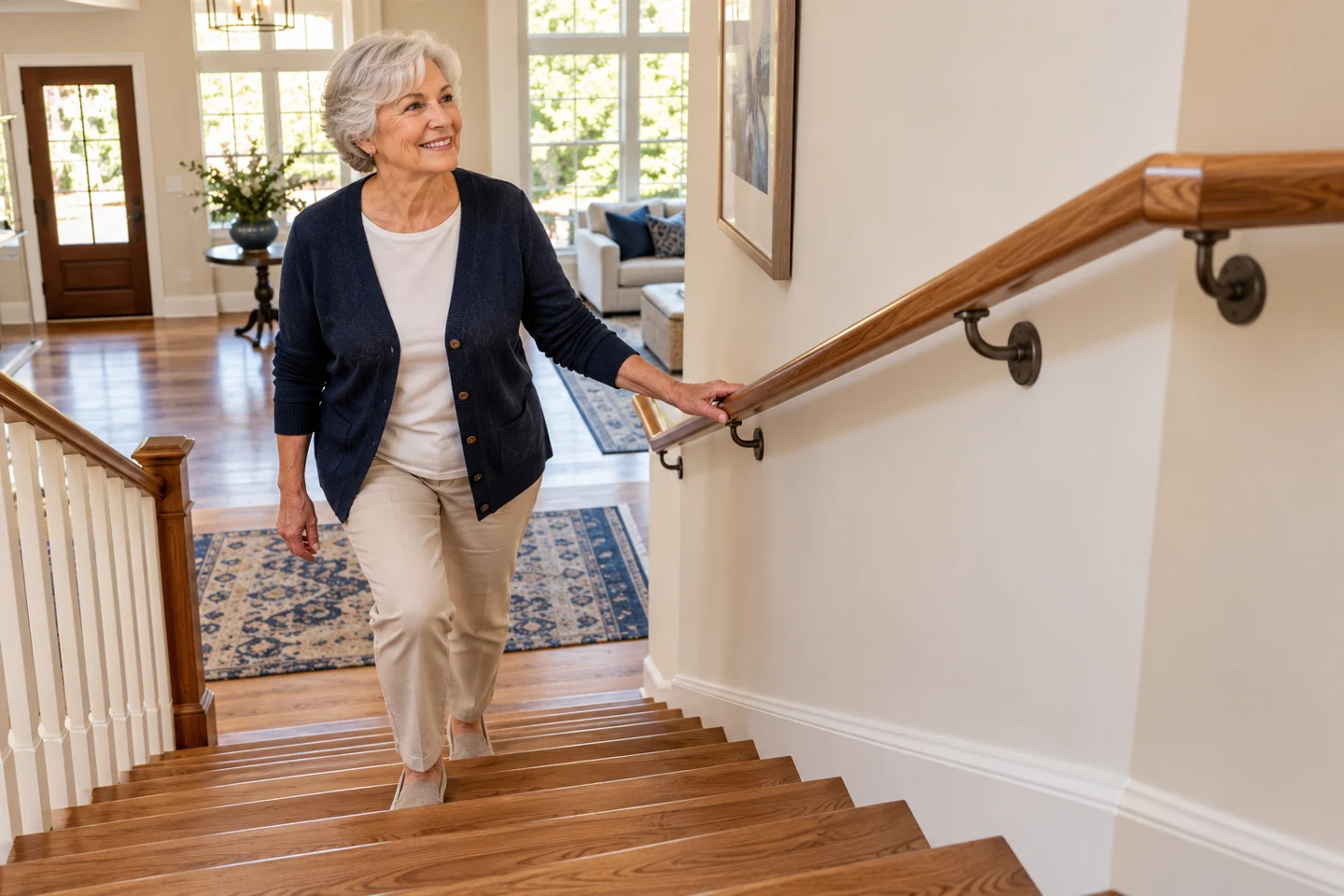
Choosing Between a Wood Stair Railing and a Metal Handrail
A wood stair railing, a wooden handrail for stairs, or a metal handrail for stairs can each be appropriate, depending on the staircase and the person using it. The label or material alone does not tell you whether the rail offers a secure grip, suitable placement, and reliable mounting.
When comparing a staircase banister with a purpose-designed handrail, consider:
- Grip: Can the intended users comfortably wrap their hands around it?
- Continuity: Does it provide support along the parts of the staircase where it is needed?
- Mounting: Can it be securely attached to the wall or supporting structure?
- Clearance: Will a second rail fit without making the stairs harder to use?
- Maintenance: Will the surface remain firm, stable, and easy to hold?
Hardwood handrails for stairs may suit a home’s existing finish, while a metal stair railing may fit other layouts or maintenance preferences. For stairs with wooden railing already in place, check whether the existing rail is secure and comfortable before assuming that replacing it is necessary.
Whether you are considering handrails for staircases indoors or outdoor stair railings at an entry, the mounting surface and exposure conditions matter. An exterior stair railing needs to be suitable for the location and weather, and larger porch or landing work may require a separate structural review.
Installing Stair Railing: Why Site Conditions Matter
Installing stair railing is not simply a matter of choosing a style and attaching it wherever it looks right. Stair construction, wall materials, rail length, landings, and applicable requirements all affect the appropriate plan.
That is why installing a handrail on stairs, especially a second rail, should include a review of the intended mounting points and how people move through the space. A rail that cannot be securely mounted or that narrows an already tight route may need a different approach.
Our Stair & Hallway Safety Package focuses on traction, pathway lighting, visibility, and minor improvements to existing rails. A new handrail is not included in the standard package and is evaluated and priced separately after we review the stair construction and mounting conditions.
For a wider look at the home, our Whole-Home Safety Assessment is a nonclinical review of areas such as stairs, hallways, entrances, lighting, and pathways. The published price is $295, with installation materials and modification work separate unless specifically agreed and quoted.
We do not have a published price for a new or dual handrail. The cost depends on the stair and mounting conditions, so we recommend getting a site-specific quote instead of relying on a general estimate.
Dual Railings for Aging in Place and Home Modifications for Seniors
Good aging in place planning looks at the whole path through a home, not just a single feature. A second handrail may help in one location, while better lighting, clearer stair edges, improved traction, or a secure existing rail may be the more relevant change elsewhere.
Home modifications for seniors should reflect the home’s layout and the person’s routines, preferences, and abilities. That might mean checking stairs used every day, improving a dim hallway, or addressing an entrance that becomes difficult to navigate.
Families comparing seniors home modifications can begin with a simple list of concerns: where support is needed, when the route is used, and what feels hard or uncertain. We can review the physical environment and outline priorities, while a healthcare professional can address clinical questions about balance, strength, or repeated falls.
What the Research Can and Cannot Tell Us About Dual Railings
Research on rail use and balance recovery helps explain why access to a graspable handhold may matter. The cited handrail-design paper notes prior studies in which approximately 67 to 81 percent of younger adults attempted to grasp a handrail or guardrail after unexpected balance loss on stairs.
That finding supports the importance of having an accessible, secure rail. It does not show that the same percentage of older adults recovered, prove that every staircase needs two rails, or establish that dual railings alone prevent falls. The user, the physical stair design, and the study context all matter.
Rules for stair handrails also vary by jurisdiction and building type. Before adding a second rail or changing an existing staircase railing, check the applicable requirements and have the mounting and layout reviewed.
Frequently Asked Questions
Are dual railings safer than one handrail on stairs?
Dual railings can make a handhold available on either side, which may be helpful for people with different reach, strength, or support needs. They are not automatically safer for every staircase, so layout, secure installation, and the needs of the people using the stairs should guide the decision.
Do older adults need handrails on both sides of the stairs?
Not every older adult needs two rails, but a second handhold may be worth considering when one side is difficult to reach or stairs feel unsteady. For repeated falls or changing balance, discuss personal needs with a healthcare professional and review the home environment separately.
Can dual stair handrails prevent falls?
No rail can guarantee that a fall will not happen. Dual stair handrails can provide another opportunity to grasp a stable support, while good lighting, traction, clear pathways, and suitable clinical guidance address other parts of stair safety.
What is the best railing for stairs for balance recovery?
The best railing for stairs is one that is reachable, comfortable to grip, continuous where needed, and securely mounted for the specific staircase. Material matters less than the rail’s shape, position, stability, and fit for the people who use it.
Can I add a second handrail to an existing staircase?
Often, a second rail can be considered, but the stairs, wall or support structure, clearances, and applicable requirements need review before installation. Major new handrail systems may need separate evaluation and a site-specific quote.
How much does a new or dual stair handrail cost in 2026?
We do not have a published price for a new or dual stair handrail in the service information available for 2026. The scope and cost depend on the staircase and mounting conditions, so request a quote based on the actual site.
Conclusion: Dual Railings and Balance Recovery
Dual Railings: Why One Handrail Isn’t Enough for Balance Recovery comes down to access and fit. Two-sided support may give a person another reachable handhold, but the right setup depends on the user, staircase, installation conditions, and any applicable requirements.
As part of aging in place planning, consider the rail alongside traction, lighting, visibility, and the condition of the full stair route. We can review those physical home-safety factors, explain when a major new rail needs separate evaluation, and help families identify practical next steps.