
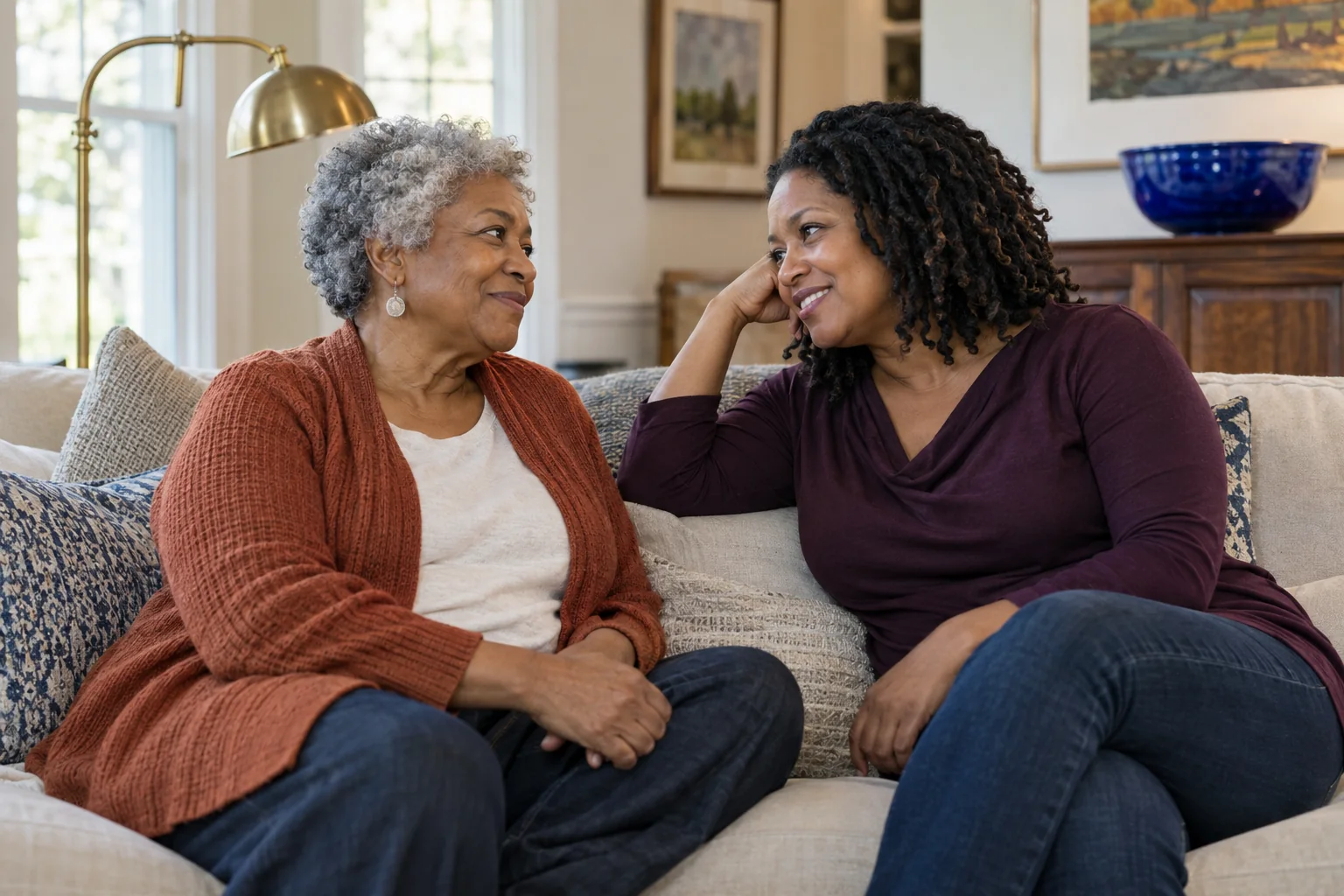
Start with the goal: keep everyday life working
Worrying about a parent can make you want to solve everything at once. Start by asking what matters to them and what has become harder, less comfortable or less predictable at home. A grab bar, shower chair, ramp or bathroom change makes more sense when it supports a routine they want to keep.
Ask which moments at home matter most to your parent. It might be a shower, getting out to see a neighbor, making tea or carrying laundry. Those details help you decide which changes are worth discussing together.
Look for change, not just age
A home that worked well five years ago may feel different after a change in balance, strength, vision, endurance, pain, medication, or confidence. Those changes may also deserve a conversation with a healthcare provider. Triangle Home Safety evaluates the physical environment; we do not diagnose the person or replace an occupational therapy, physical therapy, or medical evaluation.
For the home itself, focus on the places where small barriers create repeated friction: a dark hallway, a loose rug, a tub edge that is difficult to step over, a stair rail that does not feel dependable, or a threshold that catches a walker.
Walk the home in the order your parent actually uses it
Entrances and exits
- Are steps, landings, and thresholds easy to see and navigate?
- Is there useful lighting for evening arrivals?
- Are door locks and handles easy to operate?
- Does the most-used entrance have a stable place to pause or hold when needed?
Bathrooms
- Is getting into and out of the tub or shower becoming difficult?
- Would a fixed grab bar, shower seat, or traction improvement help?
- Is the route to the bathroom well lit at night?
- Is getting up from the toilet becoming harder?
Stairs, halls, and common pathways
- Are handrails secure and easy to use?
- Are stair edges and changes in level easy to see?
- Are cords, furniture, rugs, or clutter narrowing the path?
- Is lighting available where the person actually walks after dark?
National Institute on Aging and CDC fall-prevention guidance similarly emphasizes clear walking paths, better lighting, secure rails, grab bars, and removal of common trip hazards as home-safety steps.

Separate three kinds of problems
A useful plan separates issues into three buckets.
- Home-environment issues: lighting, hardware, grab bars, thresholds, traction, furniture placement, and other physical conditions.
- Clinical or functional questions: how a person transfers, uses a walker, manages fatigue, remembers routines, or responds to medication. These may be better addressed by a healthcare professional or occupational therapist.
- Construction issues: major structural changes, new plumbing or electrical work, rebuilt stairs, wall relocation, or full bathroom remodeling.
No single provider should pretend to own all three categories. A strong aging in place plan often involves the right people at different stages.
If you live in another city or state
Adult children often become the organizer even when they are not physically present. With the homeowner’s permission, useful documentation can include written priorities, photos of agreed work, and a completion summary. Keep one shared list of concerns, decisions, appointments, and who is responsible for each next step.
Try not to make every conversation with a parent about safety. Ask what they want to preserve: independence, privacy, routines, a favorite bathroom, the ability to use the front entrance, or the option to host family. Those priorities help determine which changes are worth making.
When a whole home assessment helps
A focused quote is usually enough when the need is already obvious—for example, a family knows it wants a fixed grab bar installed in a specific bathroom. A broader home safety assessment is more useful when several areas are involved, the family is unsure what to prioritize, there has been a meaningful change in routine or mobility, or an adult child needs a clear written picture of the home.
Triangle Home Safety’s Whole Home Safety Assessment is a nonclinical review of the physical home environment. It produces a written plan organized around what deserves attention now, what can wait, future planning, and situations where another specialist is the better fit.
Helping an Aging Parent Stay at Home: Start With Priorities, Not Products
Helping an aging parent stay at home usually works better when the family starts with the routines that matter most and the barriers that are showing up repeatedly. A bathroom, entrance, stairway, nighttime route, kitchen task, or difficult piece of hardware may deserve attention before a larger project. When several areas are involved, a written whole home plan can make it easier to separate immediate needs from future planning.